Culture Karaoke
The keynote the audience writes.
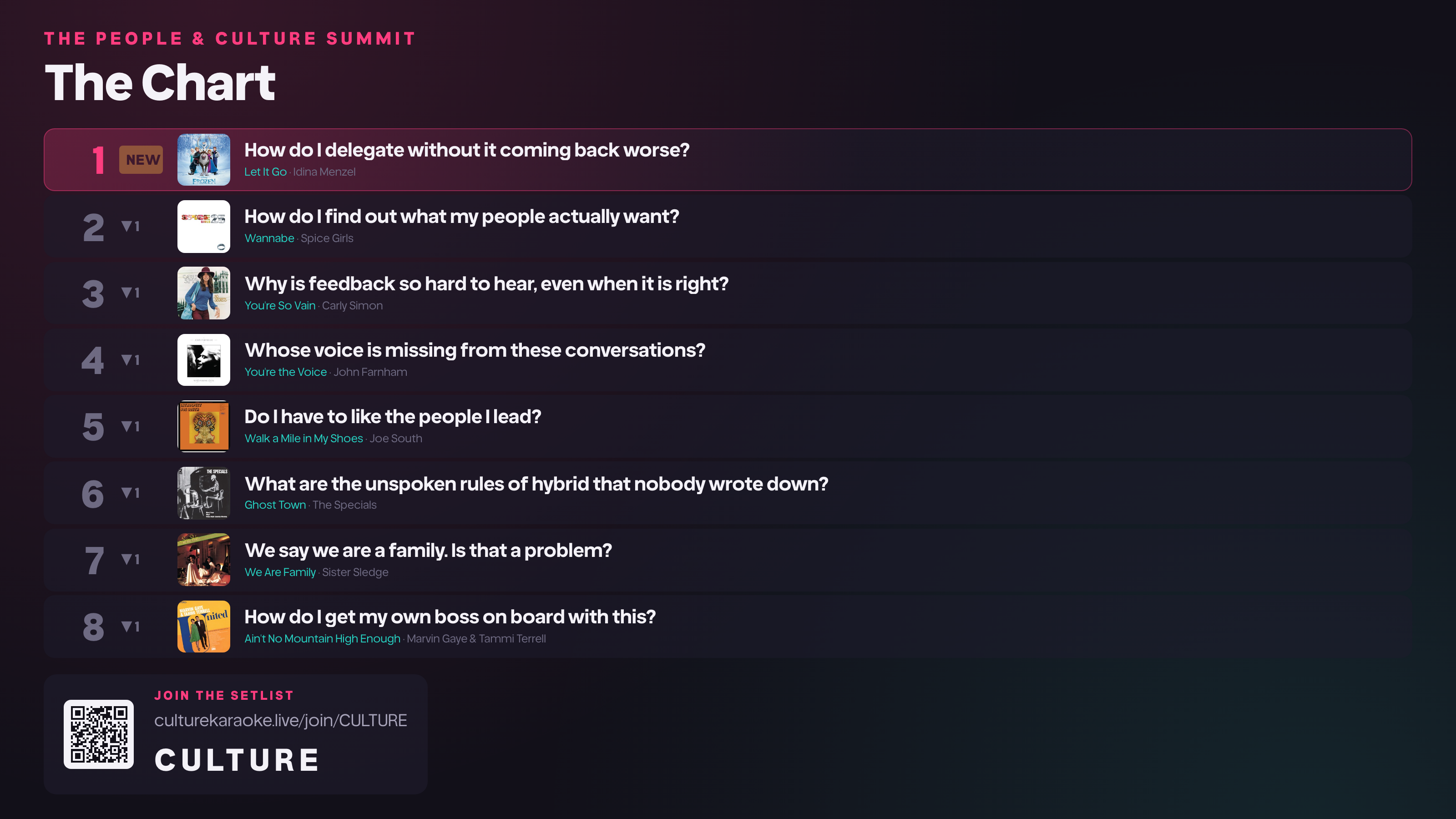
The room requests and votes for the culture questions it most wants answered. Whatever they push to the top is what gets tackled, live, in that order. Every question arrives paired with a song, and the chart moves on the screen while they watch.
- 0slides
- 3votes each
- 80+questions in the songbook
- 1action they leave with
The problem
What is broken with modern conferences
Six frustrations every delegate has felt, and quietly accepted as the cost of a conference.
- 1Death by PowerPoint
Sixty-seven slides and a mountain story that could have been an email.
- 2Devices out
Half the room checked out, because the format gave them no reason to stay in it.
- 3Not relevant to me
Interesting enough, and nothing to do with the work anybody does on a Tuesday.
- 4Deliver and disappear
On for the slot, gone before the coffee. No before, no after.
- 5Gone by the next day
A one-hour island. Nothing follows it, so it evaporates.
- 6Endured, not enjoyed
No energy in the room, just blank faces pointed at a big screen.
Every one of those is a symptom of the same thing: the room had no say in what happened to it. So the room gets the say.

What the room watches. Their questions, in the order they voted for them, each with its record. The join code and QR stay on screen the whole time.
The idea at the heart of it
Improvisation is not the absence of skill. It is the highest expression of it.
You can only be spontaneous if you have a plan. You can only improvise if you have the expertise. What is prepared is the material: every question in the songbook is written, researched and ready. What the room decides is which of them get answered at all, in what order, and which of its own questions join them.
How it runs
Three weeks out to the Monday after
Not an hour on a stage. A build-up your delegates are part of, a session they steer, and something that is still working when they get back to their desks.
Weeks out · the build-up
They get a code, and the chart starts moving
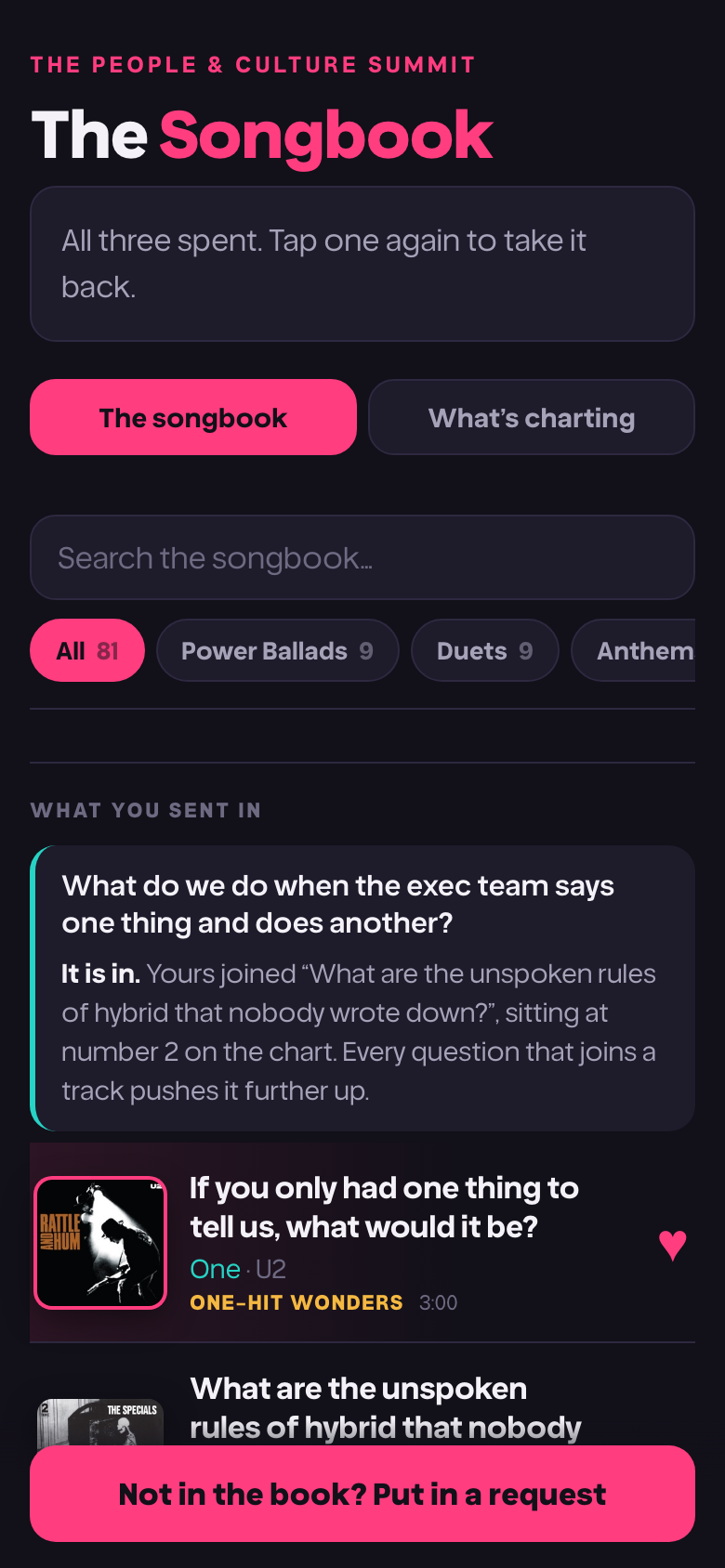
A join code goes out with the delegate email. No app, no account, no name. They browse the songbook, spend three requests on the questions they actually want answered, and write their own if it is not in there.
Questions that overlap get folded together, so near-duplicates climb instead of splitting the vote. By the time the doors open you know exactly where the room’s tension sits.

On the day · the live experience
The chart is the running order
Whatever the room pushed highest is what gets answered, in that order. The screen shows the chart moving, positions rising and falling, and the record playing behind each question.
Voting reopens in the room, and everybody gets their requests back. Only a handful of questions fit a slot, so what the room does in that moment decides which ones make it, not just the sequence. Nothing unprepared can win: the live round only ever offers questions that already charted.

The Monday after · the follow-through
It does not evaporate
Most keynotes vanish the moment they finish. This one leaves a page: the setlist exactly as the room voted it, and one thing to do. Not a reading list, not a slide deck. One action, specific enough to do on Monday without asking what it meant.

The bits people talk about afterwards
Two details that give it away
Small things, and the reason a format built on karaoke is more than a metaphor.
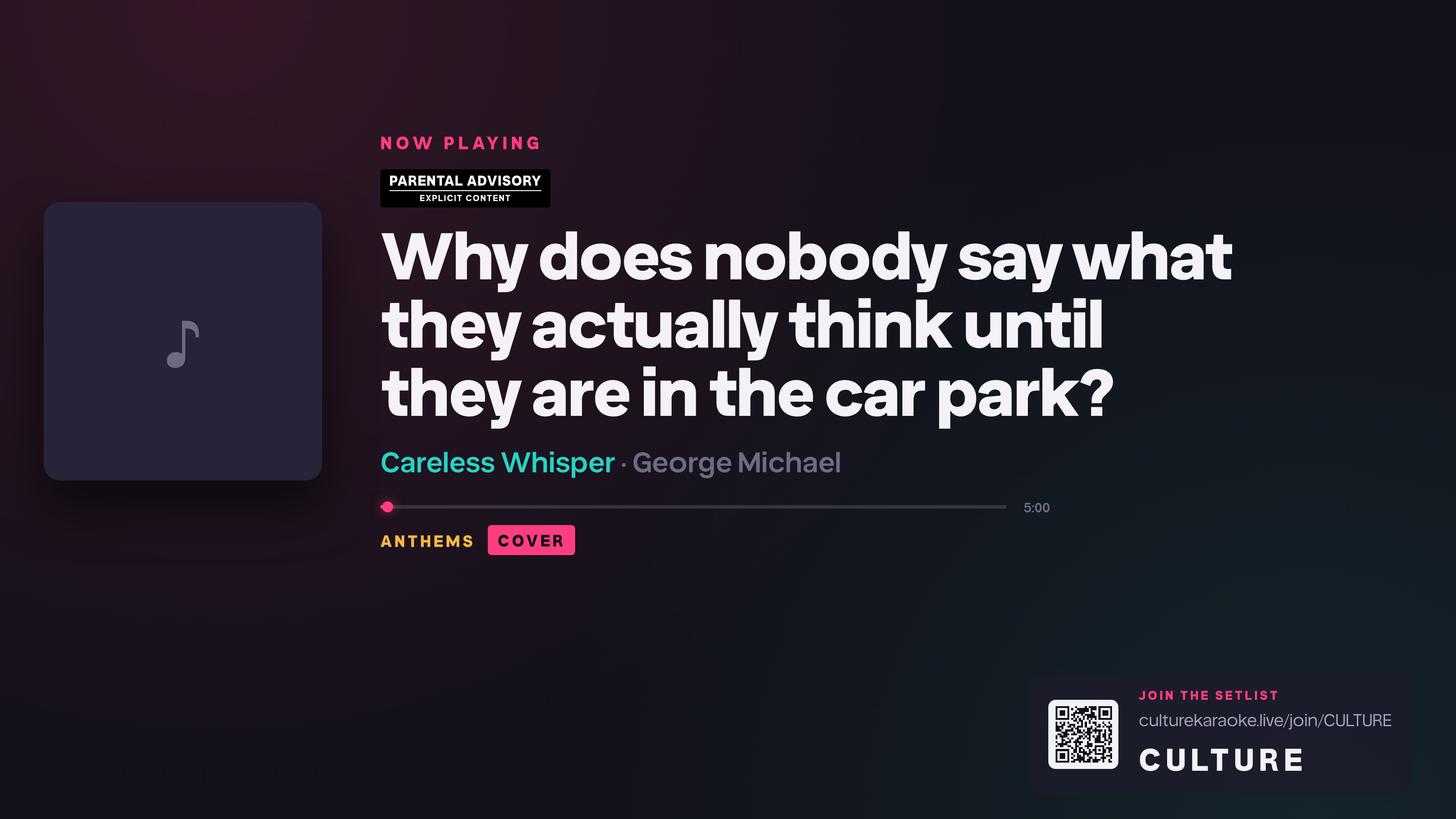
Nobody signs their name to anything, so the honest questions turn up. If somebody flags one as blunt, it goes up on the screen wearing a parental advisory sticker, exactly like a record that earned one.
It is a joke and it is also permission. The question people were only ever going to ask in the car park gets asked in the room instead.
Every question can carry one, the way a request has done on the radio since the 1950s. For everyone on the third floor. For my last manager. For the team who had to sit through the values workshop.
They are read out with the question. It is the single most reliable laugh of the session, and it is entirely written by the room.

A real one, on the screen. The sticker is the format telling the room it is safe to be honest, and the COVER tag means somebody in the audience wrote the question.

Every question is paired with a record. It is the reason the room leans in, and the reason they can still name three of them a week later.
What your delegates get
A reason to stay in the room
When a question somebody wrote gets answered, their phone tells them it was theirs. Nobody else in the room can see it. It is the difference between watching a keynote and having written one.
A code and a browser. No app, no account, no email address, no name attached to anything. The questions worth asking are usually the ones nobody wants their name on.
It cannot be irrelevant to the room, because the room chose it. Not a topic guessed at from a brief six months ago.
One action, and a page they can send to the people who were not there.
People remember the experiences they were part of.
Culture Karaoke runs on its own platform, built for the format: the songbook, the voting, the chart on the screen, the run sheet behind it and the page that lands afterwards.
